Monday, October 27, 2014

Assessments that are so much more

When I was in high school, opportunities to demonstrate my understanding sometimes looked like this:


rarely looked like this:


and usually looked like this:

BOOORING. Not to mention frustrating and exhausting. When, besides taking future tests, will filling in bubbles benefit my life? Since when has understanding been gauged by listing what you know? So much of my high school experience resembled a fill-in-the-dot assembly line, it doesn't bear remembering.


In my biology class, we never applied our knowledge to respond creatively to writing prompts of any kind. By doing labs, I learned how to keep a lab notebook organized and succinct. Occasionally we wrote summative lab reports, and once we had the option of an extra-credit research paper about a genetic disorder (I chose Crohn's disease).

It's a shame, really, because I loved the applications of biology - especially labs - and would have enjoyed writing creatively about them or applying my knowledge about them to respond to a prompt. I never felt limited in biology class, but I know that varied assessments would have been liberating.
I loved writing in my English class, and building set in Production Practicum, acting in Theater, and the oral tests in Spanish - but I never did any of these things in the discipline I loved the most.

Ever since declaring my Theater Education minor, I have vowed not to follow in my biology teacher's footsteps (sorry Mr. B). Teachers can assess their students in so many ways - and in ways that connect to students' strengths!

Our students could
  • Create models!
  • Complete labs and write reports!
  • Write and perform a reader's theatre!
  • Design, test, and reflect on their own model-based inquiry project (it's like doing a lab, but the outcome isn't written in a teacher's manual somewhere)!
  • Write a rap!
  • Write (letters, reports, summaries, pamphlets, websites, newsletters, observations, reflections, journal entries) as (doctors, scientists, reporters, farmers, explorers, aliens, concerned denizens, indigenous peoples, waterfowl experts, zoologists) about (environmental problems, common misconceptions, interesting phenomena, unique insights, personal experiences, events of local or historical significance, family concerns, current issues, best practices, ethical concerns, important questions)!
  • Create presentations!
  • Argue a point of view using science-based evidence!
  • Teach material to each other!
  • Identify, brainstorm, and implement solutions for a local environmental problem!
  • Film an informational video!
  • Debate other students, in-role, using role-appropriate costume, vocabulary, diction, and arguments!
  • Build something!

The possibilities are endless! (I intend to use all of these. Just watch me)

Best of all, most of these ideas are examples of Performance-Based Assessment - assessments which tie to students real-lives, and engage them in applying their understanding to unique venues using skills they will use as adults. Students not only enjoy PBA more, they can easily see the relevance of what they are learning. I hope that by engaging in these assessments, I'll promote rich understanding of the material among my students.

Of course, PBA takes time, energy, trial-and-error, and (heaven for-fend!) carefully constructed rubrics, but I find that the level of rigor they push myself and my students towards is worth it. When students are in role - either as zoologists writing observations about snails or as students building a bridge - they elevate themselves to the occasion, and the assessment is suddenly more than just a "test" - it's a learning adventure in its own right.

Monday, October 6, 2014

Protein Problems


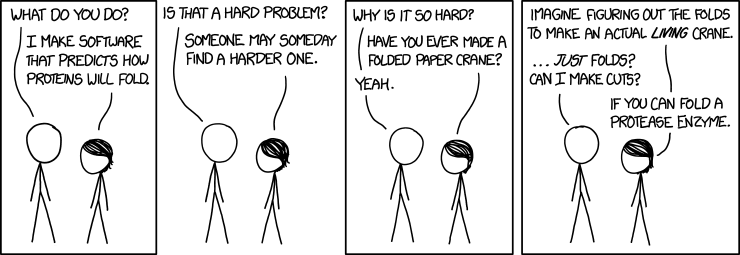
For me, one of the coolest things going on in biology is stuff like this. That scientists can write unique strands of DNA, create proteins, and begin to predict how they fold is absolutely astounding. Even cooler is the fact that normal, everyday people online can help researchers create Ebola vaccines and develop major breakthroughs in AIDS research.Even more amazing than that, is the fact that human brains are still orders of magnitude better at solving these complicated problems than the most sophisticated computers. How's THAT for biology at work? 

When I'm a teacher I have this dream that I'll have a back corner station for students who want to stay after school, or want to do some science in their free time.This station will include my favorite science books (see previous posts), a large box of Legos (and the newly released set of female Lego scientists), books of DIY safe science experiments, and maybe a few computers where students can play Foldit and Pandemic. In the case of Foldit, knowing that what you do in the game actually solves real-world problems is a huge motivator for young players. How cool would it be to have a handful of high school students contributing to Ebola research? Super cool. That's what.

Brave New World

"Space, the final frontier. These are the voyages of the starship, Enterprise. It's continuing mission: to explore strange new worlds, to seek out new life and new civilizations, to boldly go where no one has gone before." 

As a kid, these were the words I looked forward to every week. My siblings and I would sit on the floor of my parents' bedroom, watching star fields fly by, wormholes open, and alien life forms introduce themselves. The characters in TNG, and the family discussions that inevitably followed every episode, taught me that it was so cool to be smart. Wesley, Geordi, Data, Picard, and Dr. Crusher were all so intelligent and insightful - they saved lives and did incredible things with their knowledge. (And, you know, kicked butt in general.) (Especially Captain Picard. #thataccentthough)

A Budding Love
In retrospect, I think a lot of my early interest in science came from the media I consumed. Copies of National Geographic, Ranger Rick Magazine, Reader's Digest, and the newspaper were left out on the table where we read them while eating breakfast. My sister and I watched Bill Nye, ZOOM, and CyberChase on PBS, and we often tried our own experiments and crafts. I listened to NPR while I was in the car with my dad, and he explained information in the science stories I didn't understand.

And my parents had a lot to do with my interest in science as well. Every year, my mom took us to the Natural Resource festival, where we learned about Sevier County's wildlife and forests. Mom and Dad took us kids to the annual Star Show, where Patrick Wiggins from the Clark Planetarium would show us the newest images from the Hubble telescope and the latest findings in space exploration. We frequently visited museums, planetariums, and libraries on family outings, and my parents talked to us about the science and humanities involved in each exhibit. Growing up, I was constantly told that being smart in math in science "ran in the family;" my maternal grandfather was a doctor, and to be honest, this comparison boosted my confidence that I could do well in science subjects. 

If you don't think this is cool,
I feel bad for you, son.
In high school, fascinating exhibits such as Body Worlds and films such as Gattaca solidified my love of biology. I think that these experiences really connected to me because I had the tools to "dissect" them - I had been taught how to evaluate characters and appreciate themes in films, I knew how to navigate a museum with interest and confidence. More than anything, I think I connected to biology because I had a willingness to experience the awe and wonder I have always felt during these experiences, grounded in my earliest memories as a child.

My encounters with science throughout my life have been varied, interesting, and always fun. When I think of science, I think of challenging problems and exciting discoveries. I love learning about the process of science, and especially the story of the scientists. I always feel wonder considering the complications of science itself, and the human side of science. 

A Brave New World
But I know that my experience is, in many ways, unique. Not all students have had the opportunity to connect to science as I did, and even when science is shown in a "fun" way, not all students appreciate it the same. In fact, one of the problems I run in to quite frequently while I teach is assuming that students are just as excited about what I'm talking about as I am. In a way, I think teacher enthusiasm is a boon for students, but I'm also aware that some students "check out" because they feel as thought they can't connect to me or to the material.

Knowing this, I know it will be important to find and connect to my students' funds of knowledge - What do they watch? What do they like? What do they know already? How can  I get students to talk about what they know, what they've seen, and how they feel about it? What science are they seeing in the media they consume, and how can I tie it into my lessons? Is there a problem that they would particularly like to solve?

I also think it will be important to engage students in reflection and discussion of what they learn and its implications - discussions that involve the authentic questions and engage students in higher-level thinking. Using comprehension strategies and vocab strategies, I want my students to be able to understand what they see and read about science, so that they can use science texts to inform their world and see wonder in science.


And I hope I can give my students the same opportunities I had - stimulating field trips and films, combined with conversations that will help them make sense of what they see. By integrating these experiences with performance assessments and the chance to work as scientists (in role), maybe, somehow, I can teach my students that science is more than facts and diagrams, but a way to approach the world - a way that can fill one with wonder and fascination.